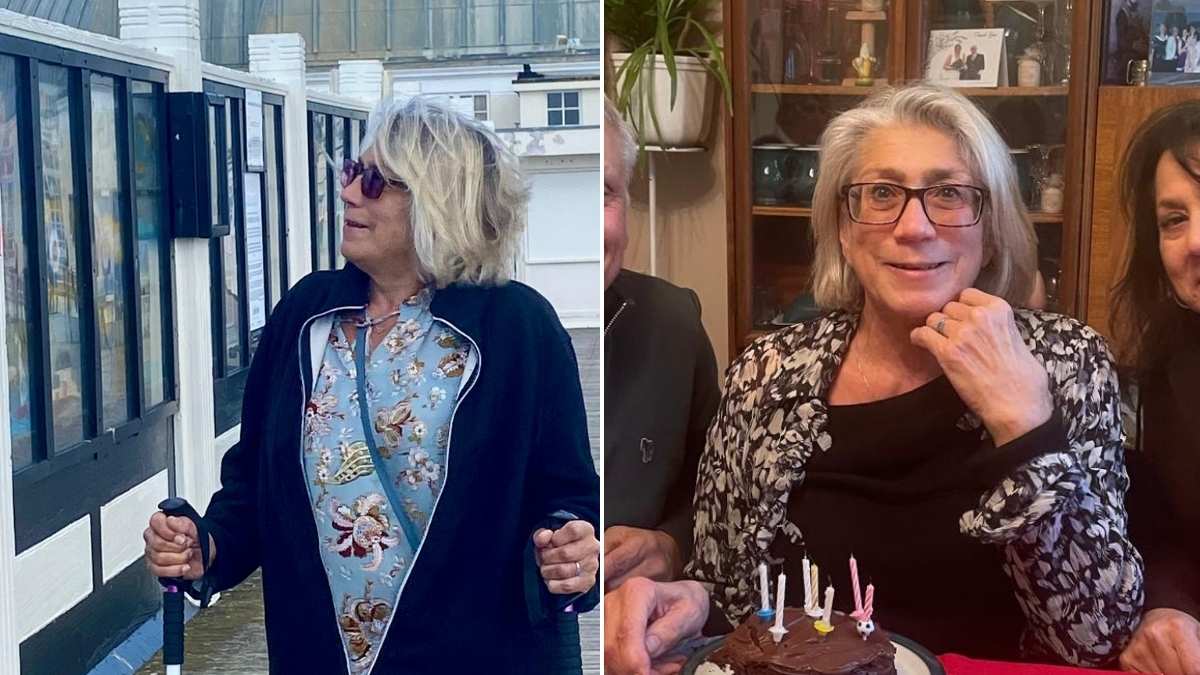
Désirée had two strokes while travelling with her husband in Tunisia. She was 69 at the time.
One year later, she took part in our Living with Brain Injury Course and, amongst new strategies to cope, she learned that she needs to be kinder to herself.
Here she talks about having a stroke abroad, adjusting to the changes and what it meant to meet people going through the same thing.
Life before the strokes that led to a brain injury
“My name is Désirée, Desi to my friends, if Désirée is too difficult. I am 70 years old and I live with my husband Richard in the village of Wraysbury, about 5 miles from Windsor.
Before my strokes I was fit and active. I used to cycle on my exercise bike 10 to 15k every other day. I exercised daily, walked, read voraciously, completed Sudoku/Crosswords, shopped, went on holiday, to the theatre, gigs, a variety of celebrations, and out for meals. I had a very full and enjoyable life.”

Désirée with family and friends
“In my other life I was a Special Needs Teacher in Hillingdon. In addition, for many years I provided an Outreach Service in both Primary and Secondary Mainstream Education.
I loved my career. It was an incredibly rewarding way to spend my days and be paid for it. I was forced to stop when my arthritis became too much to manage: I’ve had hips and knees replaced, a shoulder repair and bones removed from my hands.
In 2024 I was spending a great deal of time with my daughter Ria and her husband Al to support them through the very worst of times.
Originally we’d been told by six hospitals that Al had Glioblastoma. After many months in hospital he’d been sent home in December with little hope of him making it through to see 2025. But after two new biopsies, we couldn’t believe them: they said that it wasn’t Glioblastoma and they could treat him! Breathtakingly incredible news!
By March 2025 we were all completely exhausted and I went away for a short break.”
The first stroke had no warning signs
“On the final day of our break in Tunisia I turned to check the room and my first stroke took hold.
I truly had no warning signs and had no idea of what was happening to me.
I lost my mobility on my right side and, although Richard was asking me to walk and sit in a chair, I simply couldn’t.
The fragments of my right side that I could see seemed like glass to me and I had no control.
My husband called for help and people came running. They seemed to realise what had happened and they called an ambulance. In Tunisia, their main languages are Arabic and French; ours isn’t!
Suffice it to say I was largely unaware of what was happening during this time. Very quickly I was taken into the ambulance and driven to a hospital.
I remember little of what occurred during this time. What I do remember is the second stroke. I recall wanting to be allowed to die. It was horrible to be present and yet unable to speak or do anything to help myself. My husband tells me that the second stroke happened the following day.”
Re-learning to speak and walk, and adapting to a new life
“At the beginning I had lost all my mobility on the right side of my body and couldn’t speak. I’ve been fighting every day to make as full a recovery as I can.
I can speak now, but often lose my words, especially if I’m tired and/or emotional.
I can now walk using two walking poles, the frame, walker and stick. My poles require that I hold myself erect.”

“My strokes have resulted in the loss of a ¼ of the peripheral vision in my right eye. This means that I can no longer drive, which is extremely frustrating as I now have to rely upon my husband and friends to get me anywhere other than our village. I was fiercely independent, so the need to constantly ask for help can make me quite angry.
I can use my exercise bike for 5 to 10 minutes before I start falling off.
Most recently I’ve started to do some floor exercises every other day. I have to take it easy though, otherwise I struggle to get off the floor afterwards.
I first learned to do Sudoku and have gradually begun to complete Crosswords too.
In the last 2 weeks, I’ve managed to read a book! Yay! I’ve been unable to read at any length until now.
I tire very easily, some days being much worse than others.”
Finding peer support after a stroke and brain injury
“I’ve joined a Hydrotherapy Group called Egham Constellations. It’s a group where we come from different backgrounds and difficulties, but together we move about, exercise, swim as best we can and share a common sense of purpose.”

Désirée enjoying a social gathering with the hydrotherapy group
“This hydrotherapy is a godsend to me as I’m sure it is to the others, both victims and the helpers who attend to support us.
I’ve also attended Headway Thames Valley’s Living with Brain Injury course in Maidenhead, which I have found to be invaluable. Understanding brain injury is quite something.
Finding others who completely get me has been simply wonderful.It’s not that others aren’t there for me, they are.But no matter how much they say they get it, the fact is that they can’t fully understand the nuances of dealing with brain injury on an hour-by-hour, day-by-day basis.
Learnings from the Living with Brain Injury Course
“During the course we’ve spoken about how we’ve changed and how our partners/carers have been invaluable to us all. I’m incredibly lucky that Richard reads everything that I bring home. If I have the energy, we talk about my day, what I’ve learned and how we can together find our way back to a new kind of normal.
I’ve learned that I need to be kinder to both myself and Richard as he bears the brunt of my anger, frustration and tears.
I know that if I go a little slower, I have a much better chance of success.
This is hard because in my head I still want to get on and do.
But the effects of my strokes force me to do everything much slower and with more thought than I’m used to.”

Désirée with the Maidenhead group from the Living with Brain Injury course in August 2026
“Now that the course has finished, we are planning to keep the momentum going and meet when we can.”
Hopes for the future
“My goals are to begin to truly enjoy reading again, become more able, and improve my walking and swimming.”

“I’d love to be able to go up on my tiptoes to access the high cupboards and shelving, rather than always having to ask someone to get things down for me.
I’d love to ride my bike outside the house, but I fear that this is probably too ambitious and may remain so.”
Message to others
“Go on a course: it will massively improve your understanding. You will meet people that share the way that you approach life and understand why.
The course has taught me so much about what’s happening to me and opened up strategies that will support me in managing my life going forward.
I would love for more people to know about and understand brain injury.
I would also love for them to understand that although they can’t fix us, their patience and understanding goes a long way to assisting us as we move forward.
I truly believe that all our carers should attend a course to enable them to gain a better grasp of our situations and how to support us going forward.”
Other recovery after brain injury stories
You can also read Andy’s story about being diagnosed with a brain tumour, Len and Sue’s story supporting a partner or Lucy’s story navigating work and social life to learn about their journeys to recovery after a brain injury.
Stay connected!
Follow us on Instagram for more stories, tips and support, and subscribe to our newsletter to get updates straight to your inbox.