When Henry fell ill in the spring of 2019, he had no idea he was experiencing encephalitis and meningitis. What began as flu-like symptoms became a medical emergency. The resulting acquired brain injury changed his life significantly.
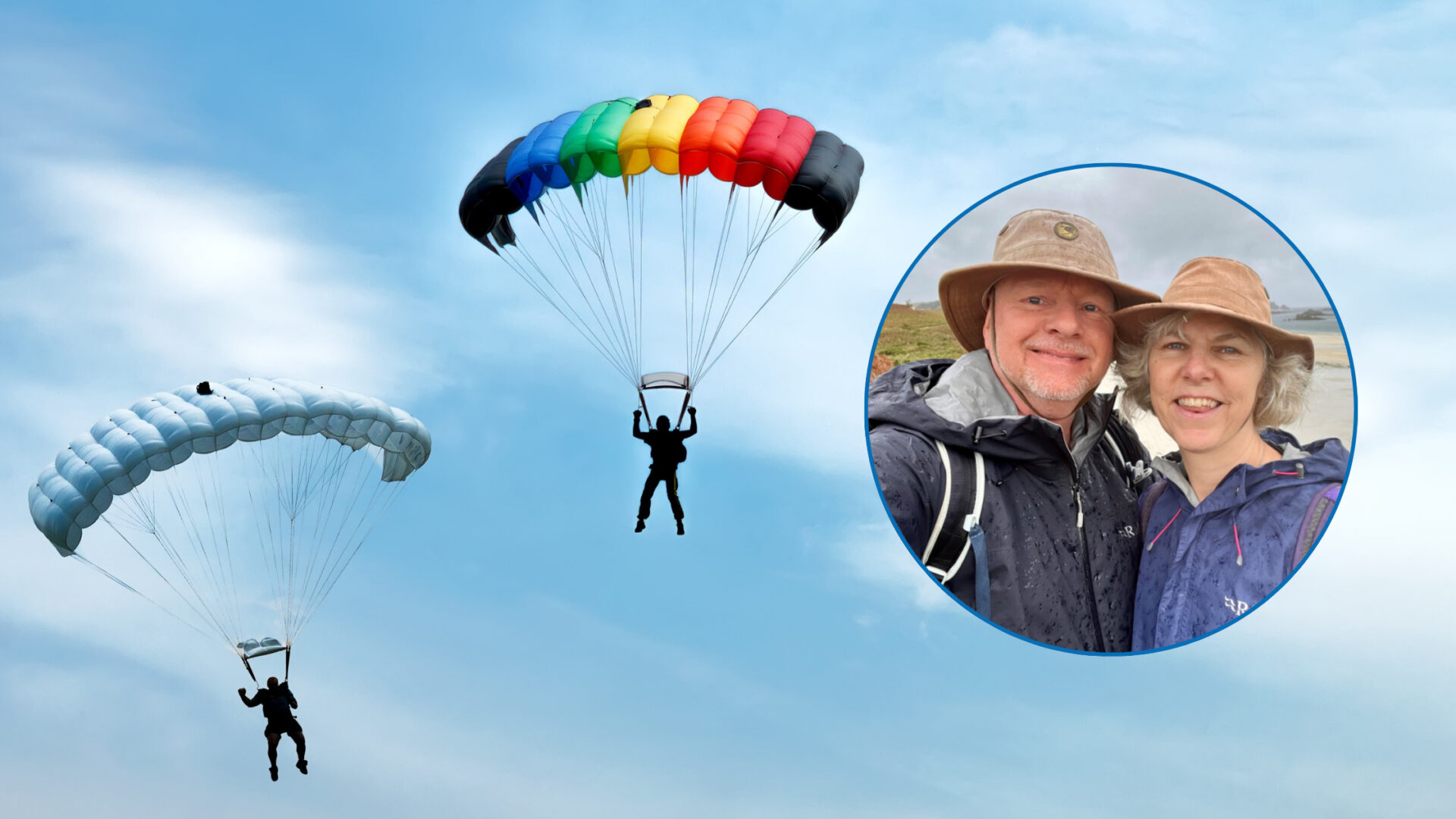
Before his episode of encephalitis, Henry and his partner Elaine were regular skydivers. They travelled to events all around the UK, Europe and the US. Skydiving was an integral part of their lives, and it was also how they met.
However, after Henry’s illness in Spring 2019, skydiving came to a stop as he had to focus on his physical recovery. Although they had planned to resume skydiving in Spring 2020, Covid-19 put a halt to their plans. Unfortunately, Henry’s brain injury means that skydiving may never again be a part of his life.
A sudden illness
Henry fell ill suddenly experiencing flu-like symptoms that progressed to severe headaches, vomiting, confusion and hiccups. Despite visiting multiple doctors and A&E, he was repeatedly dismissed as having a chest infection and sent home with painkillers.
It wasn’t until another GP observed his lack of coordination that Henry was referred to A&E and diagnosed with encephalitis and meningitis.
“Bizarrely, I also had recurring bouts of hiccups which lasted for what seemed like hours on end. A neurologist later told us this was an indication that pressure was being applied to my brain stem.”
Treatment with IV drips of anti-viral drugs and antibiotics began but was later discontinued when test results ruled out bacterial or viral causes. Due to the swelling of his brain, Henry’s salt levels started to dip dangerously low, and he was admitted to ICU. He had a sodium infusion administered and spent a couple of days in the high dependency unit.
After about three to four days Henry began to show signs of recovery, but he had no memory of his time in ICU or when his two sisters visited. Encephalitis and meningitis have overlapping symptoms and treatment is time-critical. They can be caused by bacterial or viral infections or result from autoimmune conditions.
Henry’s hospital stay revealed that his encephalitis was caused by an autoimmune condition, but the neurologists believed that it was clearing up on its own, so no high dosage steroids were prescribed. A whole-body CAT scan also revealed a peculiarity on his liver, which required an MRI scan and two agonising days of waiting for the results. Fortunately, it turned out to be a common anomaly, and Henry was discharged from the hospital after three weeks with only Ibuprofen and Paracetamol for the severe headaches.
Challenges after leaving the hospital
Henry was left exhausted and fatigued after being diagnosed with encephalitis. However, the hospital left him with no advice or details on who to contact for support, leaving him feeling lost.
After three months, Henry was diagnosed with Hashimoto’s Encephalitis. Even though it had subsided, the neurologist was not forthcoming about his long-term prognosis or how to deal with his persistent headaches.
Returning to work
Despite taking six months sick leave, Henry’s phased return to work was too soon and too fast, resulting in an increase in headaches and difficulty with routine tasks due to disturbed sleep and fatigue.
Henry consulted with his GP and was prescribed several medications, but they were ineffective and had side effects that caused drowsiness.
Even after being discharged from outpatient care by the neurologist, he received no guidance on how to cope with his persistent headaches or what support was available from external agencies.
Struggling during the pandemic
After the Covid pandemic hit, Henry began working from home, which provided some relief from the noisy office, but he still struggled to get through a whole workday.
He sought advice from charities which provided a 1:1 counselling service with fellow sufferers of encephalitis or meningitis. Henry learned that the after-effects of his illness were likely to be with him for a protracted time or possibly life, but he didn’t fully comprehend the long-term consequences at the time.
In his work environment, Henry managed to keep on top of his daily tasks. But after a team reorganisation and introduction of new tasks, he started to struggle. This led to more severe headaches, stress, brain fogs, disturbed sleep and more sick leave.
Finding specialist support
At that point, Henry stumbled across Headway Thames Valley – a charity that provided support for those with brain injuries acquired either through physical trauma or illness.
He hadn’t really heard of the concept of brain injury being a possible consequence of encephalitis. But the symptoms they described in their literature, such as recurring headaches, brain fog, problems with multitasking and memory issues, were certainly some of the things he had been struggling with for approximately two years.
Headway Thames Valley support and guidance
After a consultation with members of the Headway Thames Valley team, they agreed that he would benefit from their support. Initially, they wrote a letter addressed to his line manager to help with their understanding of his brain injury.
This described how the difficulties he was experiencing were the consequence of his illness and suggested coping strategies such as a more gradual introduction of new tasks or changes to his workload and some flexibility to permit frequent rest breaks.
With this increased understanding and working with his line manager’s support, Henry felt they successfully evolved a satisfactory way of working which left him feeling generally less stressed and helped him to assimilate such things as new tasks at his own pace.
Ongoing support and coping mechanisms
At around the same point, after a discussion with his line manager, he had another consultation with the Occupational Health team.
The outcome of this was largely in agreement with the input he had from Headway Thames Valley – mainly that, with reasonable adjustments such as a gradual introduction of new tasks, he would still be able to contribute to the team, but without detriment to his health and wellbeing.
If Henry felt he was starting to struggle again with either work-related or personal issues, he consulted Headway Thames Valley on a 1:1 basis, and they offered further advice on coping mechanisms.
Daily strategies
The most useful of these was taking maybe 20 minutes twice a day just to sit and switch off.
No music, no phone, no screens, just being alone and quiet with his own thoughts. This gave his body, and mainly his brain, an opportunity to relax and recover.
It was sometimes difficult to incorporate into a busy day, but on the majority of days, he managed it at least once a day. If he didn’t do it, however, by the end of a week, he felt he really started to run out of steam.
Life after brain injury
Henry’s life has undergone significant changes since his battle with encephalitis. He had to learn to adjust to his limitations, such as multitasking and dealing with busy environments.
However, with the help of Headway Thames Valley and the support of his partner, he was able to navigate through these challenges. Henry reminds us that with patience, perseverance, and the support of loved ones, it is possible to adapt to the changes that life throws our way.
While he may never skydive again, as it is a very fast-paced activity that requires being able to respond to things without hesitation, Henry remains optimistic about the future and continues to live his life to the fullest. He has found walking to be a great alternative and the activity has become a replacement for skydiving, taking up most of his and his partner’s weekends.
Last Autumn, Henry participated in ‘Hike for Headway Thames Valley’ and completed a 25km walk fundraising for the organisation. Despite the loss of skydiving, Henry and Elaine remain positive and grateful for the activities they can still enjoy together.
To this day, he still joins regular online support group meetings organised by Headway Thames Valley. Fellow brain injury survivors also join these meetings, and they discuss and learn from one another’s experiences, as well as receiving input and suggestion from the Headway Thames Valley team.
Other recovery after brain injury stories
You can also read Lucy’s story navigating work and social life, Leigh’s story of rediscovery, Hannah’s silent struggles, or Paul and Barbara sailing through challenging times to learn about their journeys to recovery after a brain injury.
Stay connected!
Follow us on Instagram for more stories, tips and support, and subscribe to our newsletter to get updates straight to your inbox.